Slides 📊
3.3. Measures of Variability - Range, Variance, and Standard Deviation
When describing a dataset, knowing where the center lies tells only half the story. Two datasets might share the same mean or median but look entirely different when plotted. This may be because they differ in how widely the values are dispersed. Measures of spread help us quantify this dispersion, providing a more complete picture of our data’s characteristics.
Road Map 🧭
Calculate and interpret the range as a simple spread measure.
Develop the concept of deviations from the mean.
Define and compute the variance and standard deviation.
3.3.1. The Need for Measures of Variability
When using only measures of central tendency, we often lose important information about the data’s distribution. For example:
Two countries might have the same mean family income, but one could have both greater wealth and greater poverty than the other.
Two classes might have the same average test score, but one might have consistent performance while the other has extreme high and low scores.
Two manufacturing processes might produce parts with the same average size, but one might have much tighter tolerances than the other.
Consider the visualization below, which shows two distributions with identical means but different spreads:
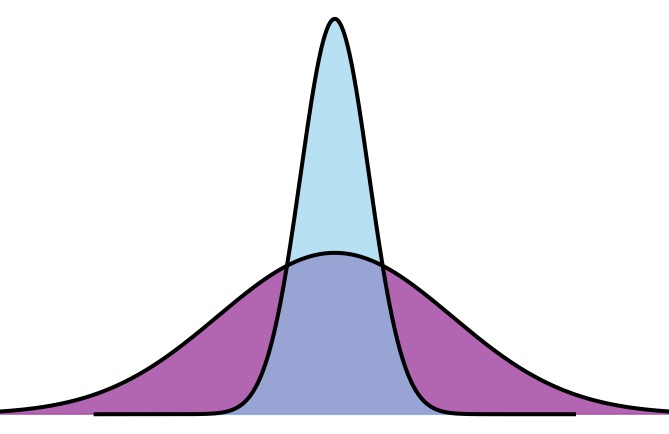
Fig. 3.3 Two distributions with the same mean but different spreads
To fully characterize these distributions, we need measures that quantify the dispersion of values around the center.
3.3.2. Sample Range: The Simplest Measure
The sample range is the most basic measure of spread—simply the difference between the maximum and minimum values in a dataset:
Example 💡: Continuing with the pet counts data
We continue to use the pet counts data from Part 1 of Section 3.2.4:
The range is \(9 - 1 = 8\).
# Creating the dataset
num_pets <- c(4, 8, 7, 9, 4, 3, 5, 1, 4)

range_pets <- max(num_pets) - min(num_pets)
range_pets  # Returns 8
Limitations of Sample Range
While the range is easy to calculate and understand, it has significant limitations:
It depends only on the two most extreme values, ignoring all other observations.
It is highly sensitive to outliers.
Two very different distributions can have identical ranges.
To illustrate this limitation, consider three different data sets that all have the same range and central tendencies:
Set 1 |
-15 |
-1 |
-0.5 |
0 |
0.5 |
1 |
15 |
Set 2 |
-15 |
-3 |
-1 |
0 |
1 |
3 |
15 |
Set 3 |
-15 |
-10 |
-5 |
0 |
5 |
10 |
15 |
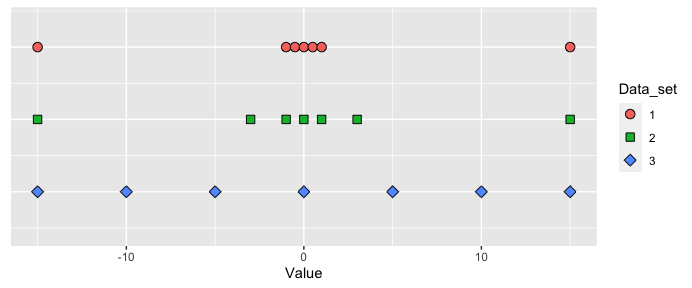
All three datasets have a range of 30 (from -15 to 15) and a mean of 0, but their distributions are clearly different. Set 1 has most values concentrated near the center with only a few extreme points, Set 2 is less concentrated, and Set 3 has values more evenly distributed across the range.
This example demonstrates why we need measures that consider the dispersion of all values in the dataset, not just the extremes.
3.3.3. Sample Variance and Sample Standard Deviation
Deviations from the Mean
To better measure the spread, we need to consider how far each data point lies from a central value, typically the mean. This distance is called a deviation.
For each observation \(x_i\), its deviation from the sample mean is defined as:
Deviations in Pet Counts Data
Let’s calculate the deviations for our pet counts data set using \(\bar{x} = 5\). The values are recorded in Table 3.2.
Object |
Pet Counts Data |
Deviation |
Squared deviation |
|---|---|---|---|
Formula |
\(x_i\) |
\(x_i - \bar{x}\) |
\((x_i - \bar{x})^2\) |
Value |
\(1\) |
\(1-5=-4\) |
\((1-5)^2=16\) |
\(3\) |
\(3-5=-2\) |
\((3-5)^2=4\) |
|
\(4\) |
\(4-5=-1\) |
\((4-5)^2=1\) |
|
\(4\) |
\(4-5=-1\) |
\((4-5)^2=1\) |
|
\(4\) |
\(4-5=-1\) |
\((4-5)^2=1\) |
|
\(5\) |
\(5-5=0\) |
\((5-5)^2=0\) |
|
\(7\) |
\(7-5=2\) |
\((7-5)^2=4\) |
|
\(8\) |
\(8-5=3\) |
\((8-5)^2=9\) |
|
\(9\) |
\(9-5=4\) |
\((9-5)^2=16\) |
|
Sum |
\(\sum_{i=1}^n x_i = n\bar{x} = 45\) |
\(\sum_{i=1}^n (x_i -\bar{x})=\) \(\sum_{i=1}^n x_i -n\bar{x} = 0\) |
\(\sum_{i=1}^n (x_i -\bar{x})^2=52\) |
From the final row of Table 3.2, we note an important property of deviations; they always sum to zero. This makes it impossible for their average to serve as a meaningful summary for a data set. Instead, we use the squared deviations so that only the magnitudes influence the summary, not their signs. See the right most column of Table 3.2 for the squared deviations of the pet counts data.
If signs are an issue, why not take absolute values?
Indeed, variability metrics which use absolute deviations exist. However, those that use squared deviations are far more widely adopted because of their powerful theoretical properties. We will explore these properties throughout the semester.
Sample Variance, \(s^2\)
We compute the sample variance, denoted by \(s^2\), by taking the sum of all squared deviations, then dividing it by \(n-1\):
The sample variance represents the average squared deviation from the mean, although we divide by \(n-1\) rather than \(n\). While the full theoretical explanation is not covered yet, this adjustment is made to correct for bias in the estimation.
Example 💡: Computing the Sample Variance
Let’s calculate the variance for the pet counts example. Most hard work has already been done in Table 3.2. We take the sum of the final column, then divide by \(n-1\).
Using R,
num_pets <- c(4, 8, 7, 9, 4, 3, 5, 1, 4)
var(num_pets)  # Returns 6.5
Sample Standard Deviation, \(s\)
While the sample variance is mathematically useful, it has a practical drawback–it’s expressed in the squared scale of the original unit, making interpretations difficult.
We return to the original unit by taking the positive square root of the sample variance. This value is called the sample standard deviation:
Example 💡: Computing the Sample Standard Deviation
For the pet counts example,
On average, the pet count deviates from the mean by about 2.55 pets.
num_pets <- c(4, 8, 7, 9, 4, 3, 5, 1, 4)
sd(num_pets)  # Returns 2.54951
Properties of Variance and Standard Deviation
They are always non-negative.
They equal zero only when all data values are identical.
They increase as the spread of the data increases.
The two measures always increase and decrease together.
3.3.4. Revisiting the Three Datasets with a Shared Range
Let’s return to our three datasets:
Data set |
Data values |
Variance |
||||||
|---|---|---|---|---|---|---|---|---|
1 |
-15 |
-1 |
-0.5 |
0 |
0.5 |
1 |
15 |
75.42 |
2 |
-15 |
-3 |
-1 |
0 |
1 |
3 |
15 |
78.33 |
3 |
-15 |
-10 |
-5 |
0 |
5 |
10 |
15 |
116.67 |
Although all three datasets have the same sample range (30) and sample mean (0), their variances differ substantially. Set 1, with most points concentrated near the center, has the smallest variance. Set 3, with points more spread out, has the largest variance. This illustrates how variance and standard deviation capture differences in distribution that the range misses.
3.3.5. Impact of extreme values
Let us compute the sample range, variance, and standard deviation for the updated pet counts data from Part 2 of Section 3.2.4.
New pet counts data |
||||||||
|---|---|---|---|---|---|---|---|---|
1 |
3 |
4 |
4 |
4 |
5 |
7 |
8 |
9 → 19 |
Sample range
\[19 - 1 = 18.\]Sample variance and sample standard deviation
In Part 2 of Section 3.2.4, we computed the new sample mean as \(\bar{x} \approx 6.1111\). We must re-compute the squared deviations for all data points using this new value:
Table 3.4 Deviations and Squared Deviations from the Sample Mean Object
Updated Pet Counts Data
Updated Squared deviation
Formula
\(x_i\)
\((x_i - \bar{x})^2\)
Value
\(1\)
\((1-6.1111)^2=26.12\)
\(3\)
\((3-6.1111)^2=9.68\)
\(4\)
\((4-6.1111)^2=4.46\)
\(4\)
\((4-6.1111)^2=4.46\)
\(4\)
\((4-6.1111)^2=4.46\)
\(5\)
\((5-6.1111)^2=1.23\)
\(7\)
\((7-6.1111)^2=0.79\)
\(8\)
\((8-6.1111)^2=3.57\)
\(19\)
\((19-6.1111)^2=166.12\)
Sum
\(\sum_{i=1}^n x_i = n\bar{x} = 55\)
\(\sum_{i=1}^n (x_i -\bar{x})^2=220.8889\)
Then the sample variance is
and the sample standard deviation is
How did the measures of spread change? |
|||
|---|---|---|---|
Measure |
Before update |
→ |
After update |
Sample range |
8 |
→ |
18 |
Sample variance |
6.5 |
→ |
27.6111 |
Sample standard deviation |
2.5495 |
→ |
5.2546 |
All three measures increased after the mis-recorded 9 was corrected to the extreme value of 19. Between the sample range and sample standard deviation—both on the data’s original scale—the impact was weaker on the standard deviation. This is because the standard deviation incorporates all data points in its calculation, whereas the sample range depends only on the extremes. The increase in the sample variance is the most dramatic, but this is because it is computed on the squared scale.
3.3.6. Bringing It All Together
Key Takeaways 📝
Central tendency measures alone don’t fully describe a dataset; we also need measures of spread.
The range (max - min) is the simplest spread measure but depends only on the extreme values, which often have the least representative power of the data.
Deviations from the mean always sum to zero. Therefore, we construct a measure of spread with squared deviations.
The sample variance (\(s^2\)) is the average squared deviation from the mean.
The sample standard deviation (\(s\)) is the square root of the sample variance, returning to the original units of measurement.
The three measures are sensitive to extreme values.
3.3.7. Exercises
These exercises build your skills in calculating and interpreting measures of variability: range, variance, and standard deviation.
Exercise 1: Calculating Measures of Variability
A mechanical engineer measures the diameter (in mm) of 8 ball bearings from a production run:
Calculate the sample mean (\(\bar{x}\)).
Calculate the sample range.
Complete the following table to find the deviations and squared deviations:
\(x_i\)
\(x_i - \bar{x}\)
\((x_i - \bar{x})^2\)
10.02
9.98
…
…
…
Verify that \(\sum_{i=1}^{n}(x_i - \bar{x}) = 0\).
Calculate the sample variance (\(s^2\)).
Calculate the sample standard deviation (\(s\)).
Interpret the standard deviation in context: “On average, the diameter of a ball bearing deviates from the mean by approximately ___ mm.”
Solution
Part (a): Sample Mean
Part (b): Sample Range
Part (c): Deviations Table
\(x_i\) |
\(x_i - \bar{x}\) |
\((x_i - \bar{x})^2\) |
|---|---|---|
10.02 |
0.02 |
0.0004 |
9.98 |
−0.02 |
0.0004 |
10.01 |
0.01 |
0.0001 |
9.99 |
−0.01 |
0.0001 |
10.03 |
0.03 |
0.0009 |
9.97 |
−0.03 |
0.0009 |
10.00 |
0.00 |
0.0000 |
10.00 |
0.00 |
0.0000 |
Sum |
0.00 |
0.0028 |
Part (d): Verify Sum of Deviations
This confirms the property that deviations from the mean always sum to zero.
Part (e): Sample Variance
Part (f): Sample Standard Deviation
Part (g): Interpretation
“On average, the diameter of a ball bearing deviates from the mean by approximately 0.02 mm.”
This indicates very tight manufacturing tolerances—the bearings are highly consistent.
Exercise 2: Understanding the Limitations of Range
Three different manufacturing processes produce parts with the following measurements (in cm):
Process A: {4.5, 4.9, 5.0, 5.0, 5.1, 5.5}
Process B: {4.5, 4.7, 4.9, 5.1, 5.3, 5.5}
Process C: {4.5, 5.0, 5.0, 5.0, 5.0, 5.5}
Calculate the range for each process.
Calculate the sample mean for each process.
Calculate the sample standard deviation for each process.
Which process produces the most consistent parts? Justify using both range and standard deviation.
Explain why range alone can be misleading when comparing these processes.
Solution
Part (a): Range for Each Process
Process A: Range = 5.5 − 4.5 = 1.0 cm
Process B: Range = 5.5 − 4.5 = 1.0 cm
Process C: Range = 5.5 − 4.5 = 1.0 cm
All three processes have the same range.
Part (b): Sample Mean for Each Process
Process A: \(\bar{x}_A = \frac{4.5+4.9+5.0+5.0+5.1+5.5}{6} = \frac{30.0}{6} = 5.0\) cm
Process B: \(\bar{x}_B = \frac{4.5+4.7+4.9+5.1+5.3+5.5}{6} = \frac{30.0}{6} = 5.0\) cm
Process C: \(\bar{x}_C = \frac{4.5+5.0+5.0+5.0+5.0+5.5}{6} = \frac{30.0}{6} = 5.0\) cm
All three processes have the same mean (5.0 cm).
Part (c): Sample Standard Deviation
For Process A (\(\bar{x} = 5.0\)):
For Process B (\(\bar{x} = 5.0\)):
For Process C (\(\bar{x} = 5.0\)):
Summary:
\(s_A = 0.322\) cm
\(s_B = 0.374\) cm
\(s_C = 0.316\) cm
Part (d): Most Consistent Process
Process C produces the most consistent parts.
Range: All three have the same range (1.0 cm), so range cannot differentiate them
Standard deviation: Process C has the smallest (\(s_C = 0.316\) cm)
Process C has most values concentrated exactly at the mean (5.0), with only two outlying values at the extremes. The standard deviation correctly identifies this as the most consistent process.
Part (e): Why Range Is Misleading
Range is misleading because:
It only considers the two extreme values (4.5 and 5.5), ignoring the four values in between
All three processes happen to have the same extremes, so range treats them as identical
The internal distribution of values is completely different: - Process A: values cluster near 5.0 - Process B: values are evenly spread - Process C: most values exactly at 5.0
Standard deviation incorporates all observations, revealing the true differences in consistency
This is why standard deviation is generally preferred over range for assessing variability.
Exercise 3: Effect of Outliers on Variability Measures
A data analyst records the response times (in milliseconds) for 10 server requests:
Calculate the range, variance, and standard deviation.
One request experienced a timeout and took 250 ms. Add this value to the dataset and recalculate all three measures.
Create a table comparing the “before” and “after” values. Calculate the percentage increase for each measure.
Which measure was affected most by the outlier? Which was affected least?
If the analyst wants to report a “typical” level of variability for this server, should they include the timeout value? Justify your answer.
Solution
Part (a): Original Data (n = 10)
Data: {45, 48, 52, 47, 51, 49, 50, 46, 53, 48}
Mean: \(\bar{x} = \frac{489}{10} = 48.9\) ms
Range: \(53 - 45 = 8\) ms
Variance:
Standard Deviation: \(s = \sqrt{6.7667} = 2.6013\) ms
Part (b): With Outlier (n = 11)
New data: {45, 48, 52, 47, 51, 49, 50, 46, 53, 48, 250}
New mean: \(\bar{x} = \frac{739}{11} = 67.1818\) ms
Range: \(250 - 45 = 205\) ms
Variance:
The outlier contributes \((250 - 67.1818)^2 = 33,422.49\) to the sum of squared deviations.
Standard Deviation: \(s = \sqrt{3,682.5636} = 60.6841\) ms
Part (c): Comparison Table
Measure |
Before |
After |
% Increase |
|---|---|---|---|
Range |
8 ms |
205 ms |
2,462% |
Variance |
6.7667 ms² |
3,682.5636 ms² |
54,322% |
Std Dev |
2.6013 ms |
60.6841 ms |
2,233% |
Part (d): Impact Analysis
Most affected: Variance (increased by about 54,322%) — variance uses squared deviations, so the outlier’s effect is amplified
Least affected: Standard deviation (increased by about 2,233%), just below the range’s 2,462%
All three measures are highly sensitive to outliers. The variance appears most affected because it’s on a squared scale.
Part (e): Should the Outlier Be Included?
It depends on the purpose of the analysis:
If reporting typical server performance:
Exclude the timeout value
Report \(s = 2.60\) ms as the typical variability
Note that timeouts occur occasionally but are exceptional
If assessing overall system reliability:
Include the timeout value
Report that variability is high (\(s = 60.68\) ms) when timeouts occur
This represents the actual user experience
Best practice:
Report both: “Typical response variability is 2.6 ms, but occasional timeouts (approximately 10% of requests) increase overall variability to 61 ms”
Investigate the cause of the timeout separately
Exercise 4: Why Divide by n−1?
This exercise explores the reasoning behind using \(n-1\) in the sample variance formula.
Consider a small population with values: {2, 4, 6}
Calculate the population variance using the formula \(\sigma^2 = \frac{1}{N}\sum_{i=1}^{N}(x_i - \mu)^2\) where \(N = 3\).
List all possible samples of size \(n = 2\) that can be drawn from this population (with replacement). There are 9 such samples.
For each sample, calculate \(s^2\) using \(n-1 = 1\) in the denominator.
Calculate the average of all your \(s^2\) values from part (c).
How does this average compare to the population variance from part (a)? What does this suggest about why we use \(n-1\)?
Solution
Part (a): Population Variance
Population: {2, 4, 6}, \(N = 3\)
Population mean: \(\mu = \frac{2 + 4 + 6}{3} = 4\)
Part (b): All Samples of Size 2 (with replacement)
Sample |
Values |
|---|---|
1 |
{2, 2} |
2 |
{2, 4} |
3 |
{2, 6} |
4 |
{4, 2} |
5 |
{4, 4} |
6 |
{4, 6} |
7 |
{6, 2} |
8 |
{6, 4} |
9 |
{6, 6} |
Part (c): Sample Variance for Each Sample
For each sample, \(s^2 = \frac{\sum(x_i - \bar{x})^2}{n-1} = \frac{\sum(x_i - \bar{x})^2}{1}\)
Sample |
Values |
\(\bar{x}\) |
\(s^2\) |
|---|---|---|---|
1 |
{2, 2} |
2 |
\(\frac{0+0}{1} = 0\) |
2 |
{2, 4} |
3 |
\(\frac{1+1}{1} = 2\) |
3 |
{2, 6} |
4 |
\(\frac{4+4}{1} = 8\) |
4 |
{4, 2} |
3 |
\(\frac{1+1}{1} = 2\) |
5 |
{4, 4} |
4 |
\(\frac{0+0}{1} = 0\) |
6 |
{4, 6} |
5 |
\(\frac{1+1}{1} = 2\) |
7 |
{6, 2} |
4 |
\(\frac{4+4}{1} = 8\) |
8 |
{6, 4} |
5 |
\(\frac{1+1}{1} = 2\) |
9 |
{6, 6} |
6 |
\(\frac{0+0}{1} = 0\) |
Part (d): Average of Sample Variances
Part (e): Comparison and Conclusion
The average of the sample variances (2.67) equals the population variance (2.67) exactly!
This demonstrates why we divide by \(n-1\) instead of \(n\):
When we use \(n-1\), the sample variance \(s^2\) is an unbiased estimator of the population variance \(\sigma^2\)
“Unbiased” means that on average (across all possible samples), \(s^2\) equals \(\sigma^2\)
If we divided by \(n\) instead, the sample variance would systematically underestimate the true population variance
The \(n-1\) correction accounts for the fact that we’re estimating the mean from the same sample we use to calculate variance, which causes us to lose one “degree of freedom”
Exercise 5: Comparing Variability Across Groups
A quality control manager compares two suppliers of electronic components. The failure times (in hours) for samples from each supplier are:
Supplier A (n = 6): {980, 1020, 995, 1010, 1005, 990}
Supplier B (n = 6): {850, 1150, 920, 1080, 970, 1030}
Calculate the mean failure time for each supplier.
Calculate the standard deviation for each supplier.
Which supplier provides more consistent (reliable) components?
The manager wants components with a mean failure time of at least 1000 hours. Which supplier better meets this requirement, considering both the average and consistency?
Calculate the coefficient of variation (CV) for each supplier, defined as \(CV = \frac{s}{\bar{x}} \times 100\%\). What advantage does CV have over standard deviation for comparison?
Solution
Part (a): Mean Failure Time
Supplier A:
Supplier B:
Both suppliers have the same mean (1000 hours).
Part (b): Standard Deviation
Supplier A (\(\bar{x} = 1000\)):
Supplier B (\(\bar{x} = 1000\)):
Part (c): Which Supplier Is More Consistent?
Supplier A is much more consistent.
\(s_A = 14.49\) hours
\(s_B = 109.18\) hours
Supplier A’s components have much less variability in failure times—they cluster tightly around 1000 hours. Supplier B’s components range widely from 850 to 1150 hours.
Part (d): Which Supplier Better Meets the Requirement?
Supplier A better meets the requirement of at least 1000 hours mean failure time.
While both suppliers have the same mean (1000 hours), Supplier A’s consistency means:
Most components will fail close to 1000 hours
Fewer components will fail well before 1000 hours
For Supplier B:
Some components fail as early as 850 hours (15% below target)
High variability means unpredictable performance
For quality control purposes, consistency is as important as the average.
Part (e): Coefficient of Variation
Advantage of CV:
The coefficient of variation expresses variability as a percentage of the mean, making it:
Unit-free: Can compare variability across different scales or units
Relative: A standard deviation of 10 means different things if the mean is 100 vs. 1000
Comparable: CV allows comparing variability between datasets with different means
In this case, Supplier A has relative variability of only 1.45%, while Supplier B has 10.92%—confirming A is much more consistent even after accounting for the scale.
Exercise 6: Conceptual Understanding
Answer the following conceptual questions about measures of variability.
Can the standard deviation ever be negative? Can it ever be zero? Explain the conditions for each.
If every value in a dataset is increased by 10, what happens to the range, variance, and standard deviation?
If every value in a dataset is multiplied by 3, what happens to the range, variance, and standard deviation?
A dataset has \(\bar{x} = 50\) and \(s = 10\). If a new value of 50 is added to the dataset, will the standard deviation increase, decrease, or stay the same? Explain.
Two datasets have the same mean. Dataset X has a larger range than Dataset Y. Is it possible for Dataset Y to have a larger standard deviation? Explain with an example.
Why do we square the deviations when calculating variance, rather than using absolute values?
Solution
Part (a): Can Standard Deviation Be Negative or Zero?
Negative: No, standard deviation cannot be negative.
It’s defined as the square root of variance
Variance is a sum of squared terms, which are always non-negative
The square root of a non-negative number is non-negative
Zero: Yes, standard deviation can be zero, but only when all values in the dataset are identical.
If all \(x_i = c\) (some constant), then \(\bar{x} = c\)
Every deviation \((x_i - \bar{x}) = 0\)
Sum of squared deviations = 0
\(s = 0\)
Part (b): Adding a Constant to All Values
If every value increases by 10:
Range: Unchanged (both max and min increase by 10, so their difference stays the same)
Variance: Unchanged (deviations from the mean don’t change because the mean also increases by 10)
Standard deviation: Unchanged
Adding a constant shifts all values but doesn’t change their spread.
Part (c): Multiplying All Values by a Constant
If every value is multiplied by 3:
Range: Multiplied by 3 (new range = 3 × old range)
Standard deviation: Multiplied by 3 (new \(s\) = 3 × old \(s\))
Variance: Multiplied by \(3^2 = 9\) (new \(s^2\) = 9 × old \(s^2\))
Multiplying by a constant scales the spread proportionally (or by the square for variance).
Part (d): Adding a Value Equal to the Mean
If we add a value equal to the mean (50), the standard deviation will decrease.
Reasoning:
The new value has deviation = 0 (it’s exactly at the mean)
It adds 0 to the sum of squared deviations
But it increases \(n\) (and thus \(n-1\) in the denominator)
More observations with the same sum of squared deviations → smaller variance → smaller s
Intuitively: adding a value at the center “concentrates” the distribution slightly.
Part (e): Larger Range but Smaller Standard Deviation?
Yes, this is possible.
Example (both datasets have mean 5):
Dataset X: {0, 5, 5, 5, 5, 10} — Range = 10, \(s = 3.16\)
Dataset Y: {1, 1, 1, 9, 9, 9} — Range = 8, \(s = 4.38\)
Dataset X has the larger range, but most of its values sit exactly at the mean, so its standard deviation is small. Dataset Y has the smaller range, but every one of its values lies 4 units from the mean, so its standard deviation is larger.
The key insight: range only considers extremes, while standard deviation considers all values. Two extreme values can create a large range while the bulk of the data stays concentrated.
Part (f): Why Square Deviations Instead of Absolute Values?
We use squared deviations rather than absolute values because:
Mathematical tractability: Squared functions are differentiable everywhere; absolute value has a “kink” at zero that complicates calculus-based analysis
Theoretical properties: Variance has powerful properties in statistical theory: - \(\text{Var}(aX + b) = a^2 \text{Var}(X)\) - For independent variables: \(\text{Var}(X + Y) = \text{Var}(X) + \text{Var}(Y)\)
Connection to normal distribution: The normal distribution is defined using squared terms, and variance/standard deviation connect directly to it
Least squares estimation: Minimizing squared errors is the foundation of regression analysis
Emphasis on larger deviations: Squaring gives more weight to larger deviations, which may be desirable for detecting outliers
Note: The Mean Absolute Deviation (MAD) uses absolute values and is sometimes preferred for its resistance to outliers, but variance remains standard due to its theoretical advantages.
3.3.8. Additional Practice Problems
True/False Questions (1 point each)
The range uses all observations in its calculation.
Ⓣ or Ⓕ
The sum of all deviations from the mean always equals zero.
Ⓣ or Ⓕ
The sample variance is always larger than the sample standard deviation.
Ⓣ or Ⓕ
If the standard deviation is zero, all values in the dataset must be identical.
Ⓣ or Ⓕ
Multiplying every value in a dataset by 2 will double the variance.
Ⓣ or Ⓕ
The sample variance formula divides by \(n-1\) to correct for bias in estimation.
Ⓣ or Ⓕ
Multiple Choice Questions (2 points each)
For the dataset {10, 20, 30, 40, 50}, the sample variance \(s^2\) is calculated by dividing the sum of squared deviations by:
Ⓐ 4
Ⓑ 5
Ⓒ 25
Ⓓ \(\sqrt{5}\)
Two datasets have the same mean of 100. Dataset A has \(s = 5\) and Dataset B has \(s = 15\). Which statement is correct?
Ⓐ Dataset A has more variability
Ⓑ Dataset B has more variability
Ⓒ Both datasets have the same variability
Ⓓ Cannot determine without knowing the ranges
If every observation in a dataset is increased by 25, the standard deviation will:
Ⓐ Increase by 25
Ⓑ Increase by 625
Ⓒ Stay the same
Ⓓ Decrease by 25
A quality engineer compares two processes. Process X has Range = 10 and \(s = 2\). Process Y has Range = 8 and \(s = 3\). Which process is more consistent?
Ⓐ Process X (smaller standard deviation indicates more consistency)
Ⓑ Process Y (smaller range indicates more consistency)
Ⓒ Both are equally consistent
Ⓓ Cannot determine without the means
Answers to Practice Problems
True/False Answers:
False — Range only uses the maximum and minimum values, ignoring all observations in between.
True — This is a fundamental property: \(\sum(x_i - \bar{x}) = \sum x_i - n\bar{x} = n\bar{x} - n\bar{x} = 0\).
False — When \(s^2 < 1\), the standard deviation \(s = \sqrt{s^2}\) is actually larger than \(s^2\). For example, if \(s^2 = 0.25\), then \(s = 0.5 > 0.25\).
True — Standard deviation equals zero only when every deviation from the mean is zero, which requires all values to be identical.
False — Multiplying by 2 will quadruple (multiply by 4) the variance. If new values are \(2x_i\), then new variance is \(2^2 s^2 = 4s^2\).
True — Dividing by \(n-1\) makes the sample variance an unbiased estimator of the population variance.
Multiple Choice Answers:
Ⓐ — The sample variance divides by \(n - 1 = 5 - 1 = 4\).
Ⓑ — Dataset B has more variability because it has a larger standard deviation (15 > 5). Standard deviation directly measures spread around the mean.
Ⓒ — Adding a constant to all values shifts the data but does not change the spread. The standard deviation stays the same.
Ⓐ — Process X is more consistent because it has the smaller standard deviation (2 < 3). Standard deviation is a better measure of consistency than range because it considers all observations, not just the extremes.